The Engineering Hiring Funnel: Are You Measuring Applications or Hiring Quality?

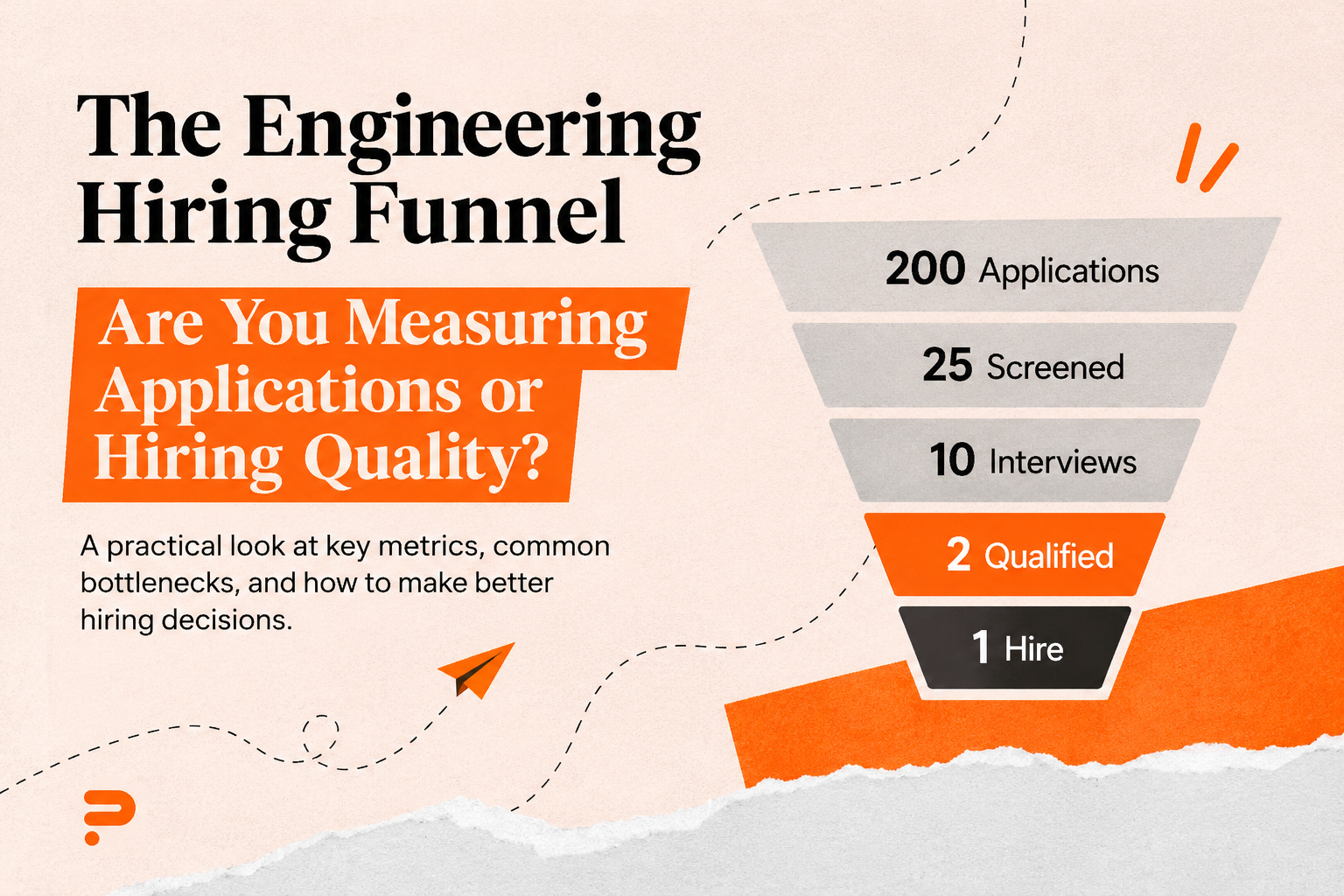
A company receives 200 applications for a Senior Backend Engineer position. The recruitment team screens 25 candidates, 10 progress to technical interviews, and after several rounds of evaluation, one candidate is finally hired.
From a hiring dashboard's perspective, the process looks successful. The position has been filled, the hiring target has been achieved, and the role can be marked as closed.
But what if the same company could have made that hire with just six technical interviews instead of ten? Or identified three technically qualified candidates instead of two, without increasing the number of applications?
Wouldn't that be a more meaningful improvement than simply attracting another 200 applicants?
This is where engineering hiring deserves a closer look.
Most organisations track how many applications they receive, how many candidates they shortlist, and how quickly positions are filled. While these metrics help measure recruitment activity, they don't always reveal the quality or efficiency of the hiring process.
For engineering teams, that distinction matters. Every technical interview involves time from engineers, engineering managers, and sometimes CTOs who are also responsible for product delivery, architecture, and technical decisions. For Talent Acquisition teams, the challenge is equally important: identifying candidates who meet the engineering bar before they reach those interviews.
The question, therefore, isn't simply how to bring more candidates into the hiring funnel. It's how to ensure the right candidates progress through it, while making effective use of recruitment and engineering resources.
In this article, we'll examine three hiring metrics, the engineering time spent on interviews, and a practical framework for identifying where the hiring process can improve.
1. Why the Engineering Hiring Funnel Deserves a Closer Look
Let's return to our Senior Backend Engineer example.
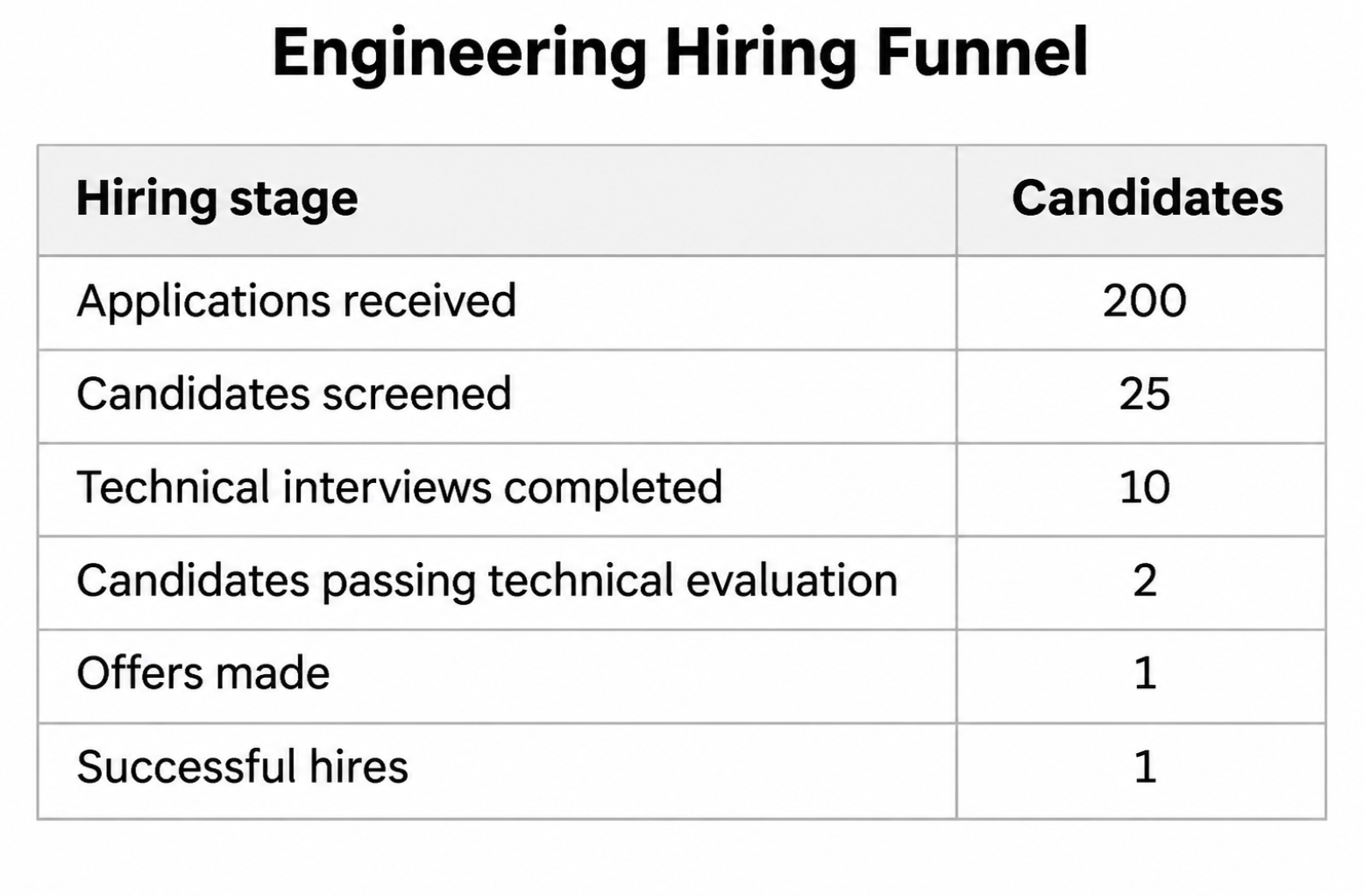
Suppose the hiring process produces the following results:
Hiring stageCandidatesApplications received200Candidates screened25Technical interviews completed10Candidates passing technical evaluation2Offers made1Successful hires1
The company received 200 applications and eventually made one hire, resulting in an application-to-hire conversion rate of 0.5%.
At first glance, that might appear inefficient. However, for a specialised engineering position, a low overall conversion rate may be entirely reasonable. The role could require uncommon technical experience, significant ownership, or expertise in systems that relatively few applicants have worked with.
The overall conversion rate doesn't explain whether the hiring process is performing well or poorly.
The more revealing questions emerge when we examine what happens between stages. Why did only 25 candidates reach screening? Why did 10 progress to technical interviews? And why did only two meet the technical requirements?
The answers could point to very different problems. Perhaps sourcing channels are attracting candidates with the wrong experience. Perhaps initial screening is too dependent on resume keywords. Or perhaps the technical evaluation criteria are not sufficiently aligned with the job description.
What Goldratt's Theory of Constraints Can Teach Us About Hiring
In The Goal, Eliyahu M. Goldratt and Jeff Cox introduced readers to ideas that underpin the Theory of Constraints, a management approach focused on identifying and addressing the factors that limit a system's overall performance.
The underlying principle is straightforward: improving a system requires understanding what is actually restricting its output. Increasing activity elsewhere may have little effect if the primary constraint remains unresolved.
Although the framework emerged from operations management, it provides a useful way to think about engineering hiring.
Consider a company whose recruitment team can generate 200 applications every month, but whose engineering team has the capacity to conduct only 20 technical interviews.
If those interview slots are already fully utilised and interview capacity is the limiting factor, increasing applications from 200 to 400 won't necessarily result in more hires. It may simply create a larger backlog.
Now consider a different situation. The engineering team has enough interview capacity, but most candidates reaching that stage don't meet the technical requirements. Here, the problem may not be interview capacity at all. It may be the quality of sourcing or initial screening.
A third organisation might have strong candidates progressing through technical interviews, only to lose them because hiring decisions take too long.
All three companies could report that engineering hiring is slow. Yet each requires a different solution.
Goldratt's framework suggests starting by identifying the constraint rather than automatically increasing activity at the beginning of the process.
Applied to engineering hiring, that might mean improving early-stage evaluation, increasing interview capacity, simplifying approval processes, or reducing delays between interview rounds.
The lesson is simple: before trying to attract more candidates, identify what is actually preventing the organisation from making successful hires.
This is why application volume should be treated as one input into the hiring process, rather than the primary measure of its effectiveness.
2. Three Metrics That Reveal More About Hiring Quality
Rather than relying primarily on application volume, engineering leaders can develop a clearer understanding of hiring effectiveness by tracking three conversion rates.
In performance management, it's useful to distinguish between activity measures and outcome measures. Application volume tells us how much activity is entering the process, while technical pass rates and offer acceptance rates reveal more about what happens as candidates progress.
Neither type of measure is sufficient on its own. The value comes from understanding how they relate to one another.
Metric 1: Screen-to-Interview Conversion
Are we shortlisting the right candidates?
In our example, 25 candidates were screened and 10 progressed to technical interviews.
The screen-to-interview conversion rate is calculated as:
Screen-to-interview conversion = (Technical interviews ÷ Candidates screened) × 100
10 ÷ 25 × 100 = 40%
This means 40% of screened candidates progressed to technical evaluation.
However, a higher conversion rate doesn't automatically indicate better screening. If nearly every screened candidate reaches a technical interview, the initial evaluation may not be sufficiently selective. Conversely, if very few candidates progress, the sourcing strategy may be attracting unsuitable profiles, or the screening criteria may be unnecessarily restrictive.
The important question is whether the initial screening process reflects what the engineering team genuinely needs.
Consider a Senior Backend Engineer role requiring Java, AWS, microservices, and distributed systems experience.
A candidate might have all four technologies listed on their resume without having independently designed or maintained a complex production system. Another candidate might have fewer exact keyword matches but extensive experience making architectural decisions, handling production incidents, and improving system reliability.
A screening process focused primarily on keywords may struggle to distinguish between them.
This is where alignment between recruitment and engineering leadership becomes important. Before sourcing begins, the team should agree on the capabilities that matter most, the level of ownership expected, and the technical experiences that genuinely indicate suitability for the role.
A well-defined screening scorecard can help translate those expectations into a more consistent evaluation process.
Metric 2: Technical Interview Pass Rate
Are we using engineering time effectively?
The second metric examines the quality of candidates reaching technical interviews.
In our example, 10 candidates completed technical evaluations, but only two met the engineering team's requirements.
Technical interview pass rate = (Candidates passing technical evaluation ÷ Candidates completing technical evaluation) × 100
2 ÷ 10 × 100 = 20%
Now imagine a different approach.
Instead of interviewing 10 candidates, the company improves its sourcing and initial evaluation process, resulting in six technical interviews. Of those six candidates, three meet the technical requirements.
The technical pass rate becomes:
3 ÷ 6 × 100 = 50%
The second process produces more technically qualified candidates while requiring fewer interviews.
This is an important distinction. The improvement isn't simply that the pass rate increased from 20% to 50%. It's that the engineering team identified more qualified candidates while spending less time conducting interviews.
For CTOs, engineering managers, and senior engineers, that difference can be meaningful.
Technical interviews often require preparation, the interview itself, written feedback, and internal discussion. Depending on the organisation, multiple engineers may participate in each round.
Research in personnel selection has examined the value of structured interviews, in which candidates are assessed using consistent, job-related questions and evaluation criteria.
For example, Michael Campion, David Palmer, and James Campion's 1997 review, A Review of Structure in the Selection Interview, examined how different elements of interview structure can improve the selection process.
The relevance to engineering hiring is clear: evaluation quality depends not only on the experience of the interviewer, but also on whether the organisation has clearly defined what it is trying to assess.
A senior backend interview, for instance, might evaluate system design, architectural trade-offs, production troubleshooting, and technical ownership against a common scorecard.
This doesn't eliminate interviewer judgement. It provides a consistent foundation for applying it.
When candidates repeatedly fail to meet fundamental requirements that could reasonably have been assessed earlier, engineering time may be used inefficiently.
The objective shouldn't be to make technical interviews easier or artificially increase pass rates. Nor should companies exclude potentially strong candidates through overly rigid early screening.
Instead, the goal is to ensure that candidates reaching engineering evaluation have a realistic chance of meeting the required technical bar.
Metric 3: Offer Acceptance Rate
Are we converting the candidates we select?
Even a strong sourcing and technical evaluation process can underperform if qualified candidates regularly decline offers.
Suppose a company makes five offers and three candidates accept.
Offer acceptance rate = (Offers accepted ÷ Offers made) × 100
3 ÷ 5 × 100 = 60%
A low offer acceptance rate could indicate several issues. Compensation expectations may not have been aligned early enough. Candidates may have received competing offers. The hiring process might have taken too long, or the role and expectations may not have been communicated clearly.
These problems require different solutions from those used to improve technical screening.
For example, if technically strong candidates are regularly declining offers because the organisation takes three weeks to make a decision, increasing application volume is unlikely to address the underlying problem.
Similarly, improving the technical pass rate won't solve a compensation mismatch.
This is why hiring metrics need to be interpreted together. Each conversion rate reveals a different part of the process, and improving the overall hiring outcome requires understanding which stage actually needs attention.
3. The Hidden Cost of Engineering Interviews
One of the most overlooked aspects of engineering hiring is the amount of engineering capacity invested in candidate evaluation.
Recruitment costs are relatively visible. Companies can track agency fees, sourcing subscriptions, job advertisements, and recruiter salaries.
Engineering time, however, is often treated as an unavoidable part of the process rather than a resource that can be managed more effectively.
Let's consider a simplified example.
Assume each technical interview requires 60 minutes of discussion and another 30 minutes for preparation and feedback. That represents 90 minutes of engineering time per candidate, assuming one engineer participates.
If 10 candidates complete technical interviews, the organisation invests:
10 interviews × 1.5 hours = 15 engineering hours
Now suppose better early-stage evaluation reduces the number of technical interviews from 10 to six while maintaining or improving the number of technically qualified candidates.
The engineering time required becomes:
6 interviews × 1.5 hours = 9 engineering hours
That's a saving of six engineering hours on a single hiring process.
For an organisation making 20 comparable engineering hires over a year, a similar reduction would represent:
20 hiring processes × 6 hours = 120 engineering hours
These figures are illustrative rather than industry benchmarks. Actual interview time depends on the number of interviewers, evaluation rounds, preparation requirements, and complexity of the role.
Nevertheless, the calculation highlights an important opportunity cost.
Those engineering hours could otherwise be available for architecture reviews, mentoring, technical planning, resolving production issues, or delivering product features.
This doesn't mean every hour saved from interviewing translates directly into additional revenue or faster delivery. Engineering work is more complex than that.
But it does suggest that organisations should consider engineering time alongside traditional recruitment costs when evaluating hiring efficiency.
A hiring process can be inexpensive from a recruitment perspective and still be costly in terms of engineering bandwidth.
4. What Happens When Shortlist Quality Improves?
To understand the potential impact, let's compare two hypothetical hiring processes for the same engineering position.
Assume both use the same technical evaluation standards and the same definition of a qualified candidate.
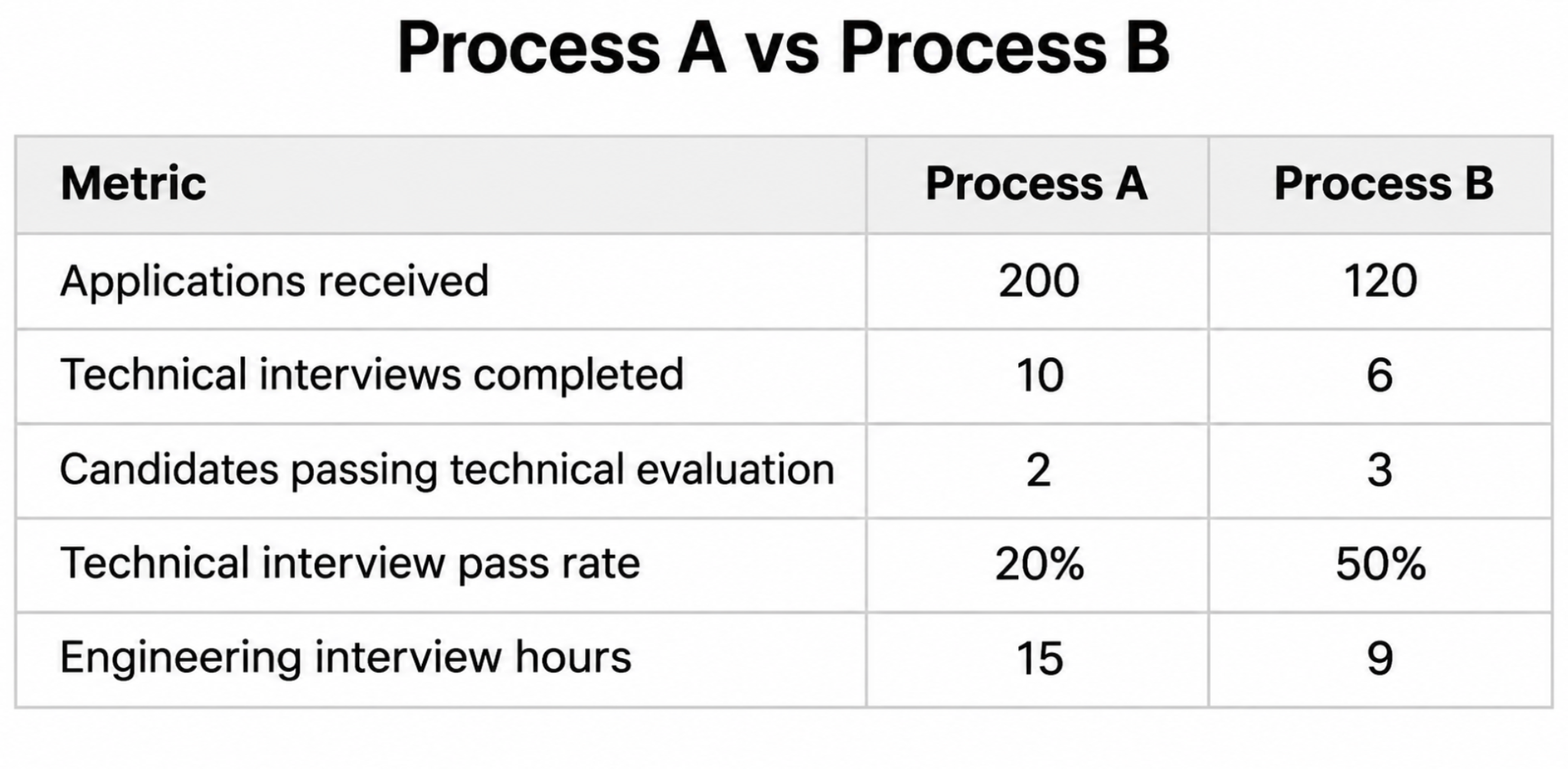
Process B receives fewer applications and conducts fewer technical interviews, yet produces more candidates who meet the engineering requirements.
This doesn't automatically guarantee a better final hire. Candidate experience, evaluation fairness, offer conversion, and performance after joining still matter.
However, it does suggest that Process B uses engineering evaluation time more effectively.
We can examine this further by introducing another useful metric: qualified candidates per engineering interview hour.
The calculation is straightforward:
Qualified candidates per engineering hour = Candidates passing technical evaluation ÷ Total engineering interview hours
For Process A:
2 ÷ 15 = 0.13 qualified candidates per hour
For Process B:
3 ÷ 9 = 0.33 qualified candidates per hour
In this illustrative comparison, Process B produces approximately 2.5 times as many technically qualified candidates per engineering interview hour.
This is not a universal benchmark, and the metric should not be used to compare fundamentally different roles or evaluation processes without accounting for their complexity.
Its value lies in helping organisations assess their own hiring processes over time, particularly when comparing similar positions and consistent technical standards.
Instead of asking how many candidates the engineering team interviewed, leaders can begin asking how effectively that time was used to identify qualified candidates.
5. A Practical Framework to Diagnose Your Engineering Hiring Funnel
Once an organisation begins tracking these metrics, the next challenge is determining what to improve.
A useful starting point is to examine four connected areas of the hiring process: sourcing quality, screening alignment, technical evaluation consistency, and candidate conversion.
Sourcing Quality: Are We Attracting Relevant Candidates?
Sourcing quality is about understanding which channels consistently produce relevant engineering candidates. A sourcing channel generating 100 applications but only one technically qualified candidate may be less effective than a targeted channel producing 20 applications and three qualified candidates.
The objective is not necessarily to maximise reach, but to understand which sources produce candidates who genuinely match the role.
For Talent Acquisition teams, this means evaluating sourcing channels beyond response rates and application volume. The percentage of sourced candidates who eventually meet technical requirements provides a more useful indicator of channel effectiveness.
Screening Alignment: Do Recruitment and Engineering Agree on What Good Looks Like?
Screening alignment focuses on whether recruiters and engineering leaders share the same understanding of what a suitable candidate looks like.
Technical keywords are useful, but they don't always reveal the depth of someone's experience. A structured scorecard covering relevant technical exposure, ownership, problem-solving experience, and role-specific expectations can help improve consistency before candidates reach engineering interviews.
For example, if a company needs an engineer who can independently own backend architecture, screening should explore evidence of architectural ownership rather than relying exclusively on years of experience with a particular technology.
Technical Evaluation Consistency: Are We Measuring the Same Capabilities?
Technical evaluation consistency becomes important when multiple interviewers assess candidates.
One engineer may prioritise algorithms, another system design, and another production experience. These perspectives can complement each other, but the organisation needs a common understanding of the competencies being evaluated and the standards candidates are expected to meet.
Without that alignment, hiring decisions can become difficult to compare and explain.
A structured evaluation framework doesn't eliminate interviewer judgement. It helps ensure that judgement is applied against relevant and consistent criteria.
Candidate Conversion: Are We Losing Strong Candidates Along the Way?
Candidate conversion examines what happens after promising engineers enter the process.
Delays between interview stages, unclear compensation discussions, repeated assessments, and slow decision-making can all affect outcomes.
Tracking candidate withdrawals, offer declines, and time between stages helps reveal problems that technical evaluation metrics alone cannot identify.
These four areas are interconnected. Making screening more selective might improve the technical pass rate, but it could also exclude strong candidates if the criteria are poorly designed.
The objective is to improve the overall hiring system rather than optimise individual metrics in isolation.
6. Building a Hiring Scorecard That Engineering Leaders Can Actually Use
A useful hiring dashboard doesn't need dozens of metrics.
For many engineering organisations, a small set of well-defined measures reviewed consistently can provide a clearer picture than a dashboard dominated by application counts and interview activity.
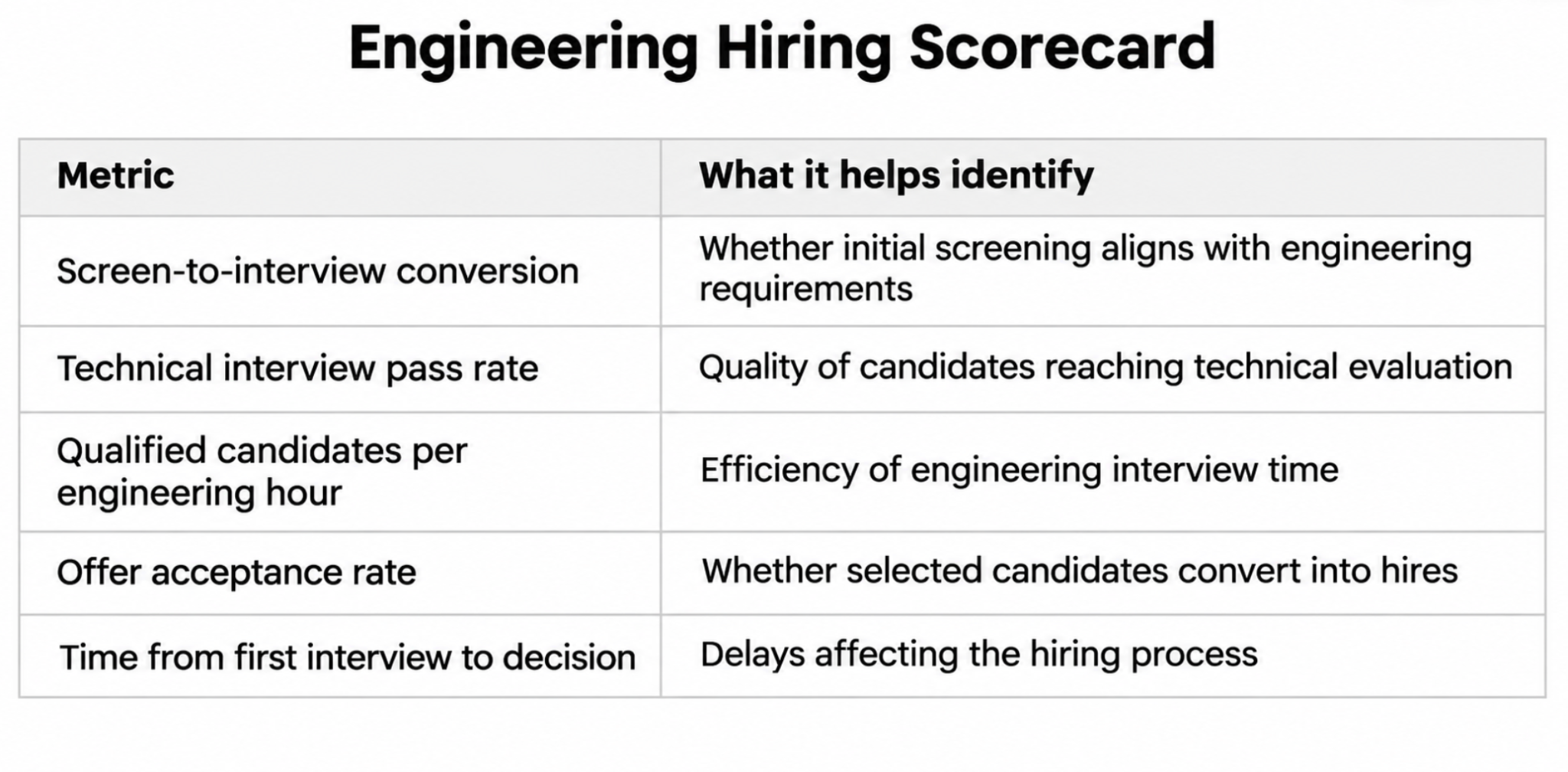
The first step is to establish a baseline using recent, comparable engineering roles.
Rather than immediately setting ambitious targets, leaders should examine where outcomes are consistently weaker and investigate the reasons.
If technical pass rates are low, the organisation may need to revisit sourcing quality, screening criteria, or the clarity of role requirements.
If strong candidates regularly decline offers, the priority may be compensation alignment, candidate engagement, or decision speed.
If engineering interview hours are increasing without a corresponding improvement in qualified candidates, the team should consider whether relevant capabilities can be assessed more effectively earlier in the process.
These improvements don't always require more recruitment tools, larger teams, or additional hiring budgets.
Sometimes the most valuable change is simply better alignment between the people identifying candidates and the engineers evaluating them.
7. Before Your Next Engineering Hire, Ask Three Questions
Before opening another engineering position, it may be worth reviewing the last few roles your organisation filled.
Where are we losing the most candidates, and why? Understanding whether the primary challenge lies in sourcing, screening, technical evaluation, or offer conversion helps avoid investing effort in the wrong stage.
How much engineering time are we investing per technically qualified candidate? This shifts attention from interview volume to the effectiveness of engineering evaluation time.
What could we evaluate earlier without compromising the technical bar? Clearer role requirements, structured screening criteria, and relevant early-stage technical discussions may help ensure that engineering leaders spend more time with candidates who have a realistic chance of succeeding.
These questions won't eliminate the complexity of engineering hiring, but they can make the process more measurable and the decisions more informed.
Final Thoughts: Measure the Quality of the Funnel, Not Just Its Size
Engineering hiring will always require human judgement.
A resume cannot fully demonstrate how someone approaches architectural trade-offs, responds to production incidents, or collaborates with an engineering team. These qualities require thoughtful evaluation, and experienced engineers have an important role to play in assessing them.
But that doesn't mean every applicant should consume the same amount of engineering attention.
A well-designed hiring process should identify relevant candidates early, apply consistent evaluation criteria, and reserve engineering time for decisions where technical judgement adds the most value.
The next time your hiring dashboard shows 300 applications for an engineering position, consider looking beyond the headline number.
How many candidates actually met the technical bar? How much engineering time did it take to identify them? And could the process produce the same or better outcomes with less effort?
Because the goal of engineering hiring isn't to generate more applications or conduct more interviews. It's to make better hiring decisions.
References & Further Reading
- Goldratt, E. M., & Cox, J. (1984). The Goal: A Process of Ongoing Improvement. North River Press. A foundational introduction to the ideas underlying the Theory of Constraints.
- Campion, M. A., Palmer, D. K., & Campion, J. E. (1997). A Review of Structure in the Selection Interview. Personnel Psychology, 50(3), 655–702. Research reviewing the role of structure in employment interviews.
*All hiring scenarios, figures, and calculations in this article are illustrative. They are not industry benchmarks or client performance claims.


