
Recruitment has always been a people business. Increasingly, it is also a data business.
Every hiring cycle generates hundreds of CVs, candidate conversations, interview notes, assessments and hiring decisions. Yet much of this information remains underutilised, while recruiters spend a significant portion of their time on repetitive administrative tasks.
Artificial intelligence promises to change that.
According to LinkedIn's Future of Recruiting 2025 report, 37% of recruiting organisations were already experimenting with or actively integrating generative AI, compared with 27% the previous year. Among teams adopting these tools, recruiters reported saving approximately 20% of their workweek.
Today, AI-powered tools can source candidates, screen applications, schedule interviews, analyse assessments and even predict hiring outcomes. As these capabilities expand, an important question emerges: Will AI replace recruiters, or make them more effective?
The answer lies in understanding what recruitment fundamentally involves.
The real opportunity is not to replace recruiters but to remove the administrative burden that prevents them from focusing on what matters most: understanding hiring requirements, evaluating candidates beyond their resumes, building relationships and making informed hiring decisions.
AI can make recruitment faster and more structured. But faster hiring does not necessarily mean better hiring.
The challenge for organisations is to understand where AI adds genuine value, where it introduces new risks and where human expertise must remain central.
Although recruitment processes differ across organisations, most follow six broad stages: workforce planning, candidate sourcing, screening, assessment, selection and onboarding.
Each stage involves a different combination of repetitive tasks, data analysis and human judgment. Understanding that distinction is essential to using AI effectively.
Before anyone is sourced, someone has to decide that a role is needed, what it should look like and how it should be described. In practice this often means a hiring manager dusting off a three-year-old job description and a recruiter trying to translate a vague brief into something a candidate would want to read.
How AI can help
The challenges
AI can write a fluent job description, but it cannot know that the team is about to lose its only senior engineer, or that the hiring manager's brief is really describing two roles. That context lives in conversations, and surfacing it remains the recruiter's job.
There is also a real risk of homogenisation: if every organisation generates its descriptions from the same models, roles start to sound identical and lose the specificity that attracts the right people.
Sourcing is where recruiters spend an enormous share of their time: searching databases and professional networks, writing outreach messages, posting on job boards and nurturing passive candidates who are not ready to move yet.
How AI can help
The challenges
Sourcing models learn from past hiring data, and past hiring data reflects past bias. A system trained on who was hired before may recommend more of the same, narrowing rather than widening the funnel.
Automated outreach also has a credibility problem: candidates can increasingly recognise machine-written messages, and a flood of them erodes employer brand rather than building it.
The recruiter still has to decide who is worth a genuinely personal approach and make that approach themselves.
Screening is the stage most often cited as ripe for automation, and for good reason. A popular role can attract hundreds of applications within days, and no recruiter can read all of them with equal attention. It is also the stage where the risks of getting AI wrong are most visible.
The scale of this challenge is evident in LinkedIn's recruitment research, which found that 22% of HR professionals spend between three and five hours a day reviewing applications. More concerningly, 73% reported that fewer than half of the applications they receive meet all the listed job requirements.
How AI can help
The challenges
This is where the cautionary tales live. Screening models have been shown to penalise career gaps, non-traditional education and names or postcodes associated with particular groups. Regulators have noticed: automated employment decision tools now face audit and transparency requirements in several jurisdictions, and the EU AI Act classifies recruitment AI as high risk.
There is a subtler problem too: the CV itself is becoming a less reliable signal.
Candidates now routinely use AI to rewrite their CVs against the job description, mirroring its keywords and phrasing so that an automated screener scores them highly. The result is an arms race in which the screener and the applicant are, in effect, two models negotiating with each other, and the recruiter sees a stack of near-identical, perfectly optimised documents that reveal very little about who can actually do the job.
Polish and fit are no longer the same thing.
The opposite failure is just as costly. Many strong candidates write poor CVs. They undersell themselves, use the vocabulary of their last employer rather than the market's, bury the relevant experience on page two, or are simply not native speakers of the language the screener is tuned for.
A keyword-driven system will rank the fluent but mediocre applicant above the awkward but excellent one, and because the excellent one never reaches a human, nobody ever finds out.
The hidden cost of over-automated screening is not the bad hires it lets through but the good hires it quietly filters out.
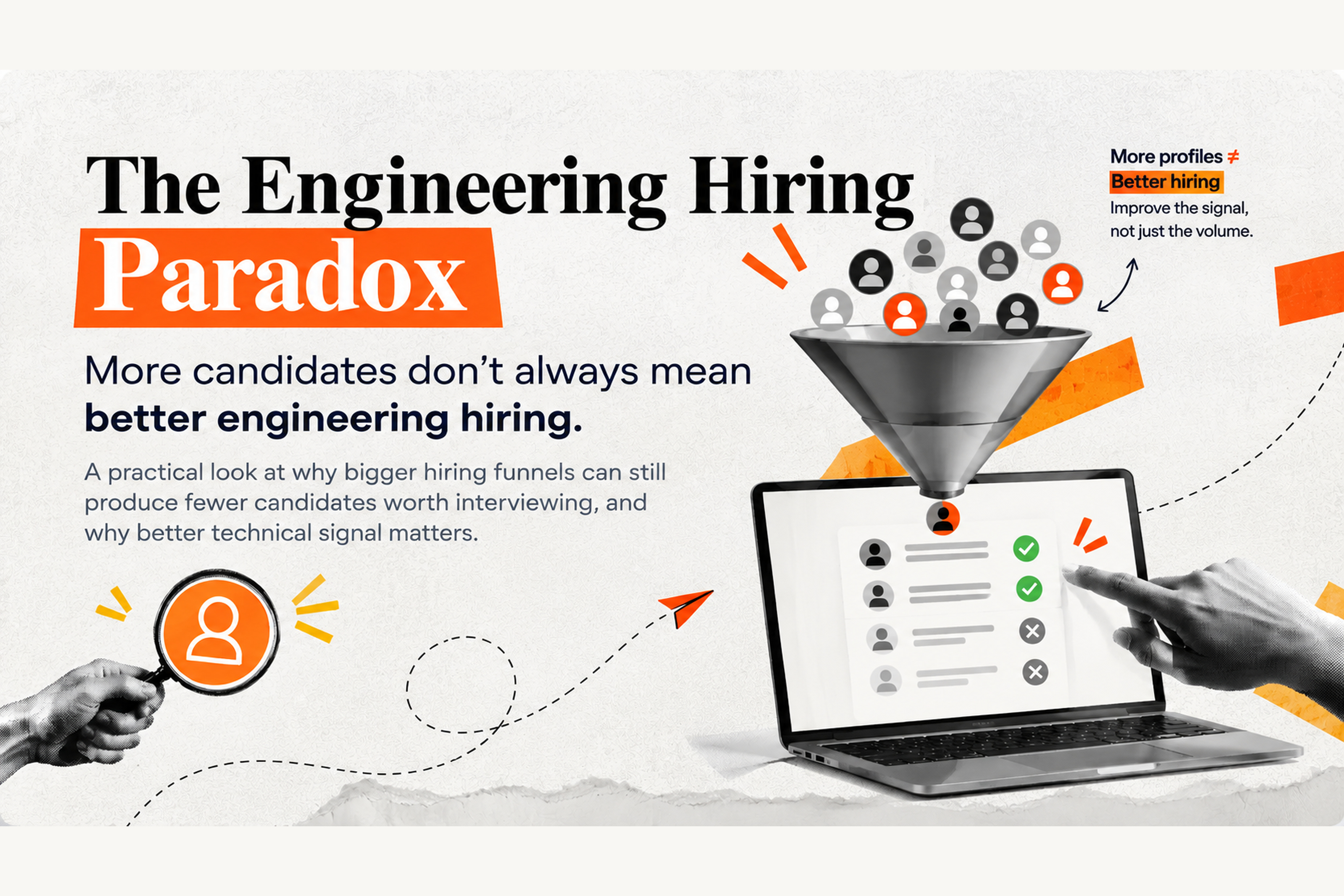
This becomes particularly important in engineering hiring.
A candidate may list multiple programming languages, frameworks and technologies without demonstrating the practical depth required to solve complex engineering problems.
For senior engineering roles, assessing architectural judgment, problem-solving approaches, technical trade-offs and leadership capability requires deeper evaluation than resume matching alone.
The practical answer is that AI should sort and surface, not reject. It can cluster applicants, highlight evidence of skills and flag outliers, but a human needs to own the decision on who does not progress and needs to be able to explain it.
Experienced recruiters also compensate for weak CVs in ways a screener cannot: a quick call, a look at a portfolio or a short work sample often tells them more than the document does.
Once a shortlist exists, the organisation has to find out whether the candidates can actually do the job and whether they will thrive in the team. This usually involves some combination of skills tests, structured or unstructured interviews, case exercises and reference checks, coordinated across several busy calendars.
How AI can help
The challenges
The line between useful and harmful is sharp here.
Transcription and scheduling are low-risk. Tools that claim to infer personality, honesty or 'culture fit' from facial expressions, tone of voice or word choice are a different matter: the science behind them is weak, candidates find them intrusive, and several have been withdrawn under regulatory and public pressure.
Fully automated one-way video interviews also tell candidates that the organisation could not spare a human to meet them, which is not the message most employers want to send to their top choice.
For specialised roles, the quality of assessment matters as much as the efficiency of conducting it.
Consider two engineering candidates who propose different solutions to the same architectural problem. Both solutions may be technically valid, but one candidate may demonstrate stronger awareness of scalability, maintainability, operational constraints and business priorities.
Understanding those differences requires experienced technical judgment.
Interviewing is a two-way assessment, and the candidate is evaluating the company just as closely.
The panel has to reach a decision, the organisation has to construct an offer that the candidate will accept, and the recruiter has to manage the negotiation, counter-offers and the anxious period between acceptance and start date.
How AI can help
The challenges
A hiring decision is an accountable act, and it should be made by people who can be asked to justify it.
AI can organise the evidence but should not cast the vote.
Negotiation is similarly human: a candidate weighing two offers is responding to how valued they feel, how honestly their questions were answered and whether they trust the person on the other end of the phone.
Predictive scores about acceptance risk can also become self-fulfilling if recruiters quietly deprioritise candidates the model is unsure about.
Recruitment does not end at the signed offer. The weeks between acceptance and a new hire's first productive month are when early attrition is decided, and they are often the most neglected part of the process.
How AI can help
The challenges
A new hire's experience is shaped by whether their manager showed up, whether a colleague took them to lunch and whether they felt expected.
No assistant can substitute for that.
There is also a data-protection dimension: onboarding involves sensitive personal information, and feeding it into AI tools without clear governance creates risk that the convenience does not justify.
Some problems do not belong to any one stage. They sit underneath the whole process, and they are the reason AI in recruitment should be adopted deliberately rather than enthusiastically.
The distinction between efficiency and effectiveness deserves particular attention.
A recruitment process that reduces screening time by 50% may appear successful. But if hiring managers subsequently spend more hours interviewing unsuitable candidates, the organisation has merely transferred the workload rather than eliminated it.
A more meaningful evaluation should include:
These measures help organisations assess whether AI is improving candidate relevance and hiring decisions rather than simply increasing the speed or volume of applications processed.
Walk through the six stages and a consistent pattern emerges.
At every step, AI is strongest at the work that is repetitive, high-volume and data-heavy: parsing, searching, scheduling, summarising, benchmarking and reminding.
At every step, the decisive moments remain stubbornly human: understanding what the business really needs, persuading a reluctant candidate to take a call, deciding who deserves a second look despite an unconventional CV, reading the room in an interview, and closing an offer on trust.
That reflects what recruitment fundamentally is: a series of judgments about people, made by people who can be held accountable for them.
AI can make those judgments better informed, faster and more consistent. It should not replace the accountability, context and professional expertise required to make consequential hiring decisions fairly and credibly.
This is something we have observed closely through our work at ProfoundIQ. In engineering hiring, AI can help improve sourcing and screening efficiency, but understanding a candidate's actual technical capabilities requires experienced judgment. That is why we involve former CTOs and senior engineering leaders in evaluating candidates before presenting them to clients. It helps us look beyond what a resume says and assess whether someone can actually meet the technical demands of the role.
The right ambition, then, is a recruiter whose time has been freed from the inbox and the spreadsheet and redirected towards candidates and hiring managers, working with tools that are audited for bias, transparent about how they reach their conclusions, respectful of candidate data and honest about their limits.
Those conditions are not yet consistently met across organisations.
Until they are, the question is not simply whether AI will replace recruiters, but whether recruiters will have the governance, training and authority to use it well.
The future of recruitment will not be defined by how much of the process organisations automate, but by how effectively they combine AI efficiency with human expertise.
That is the challenge worth solving.
.png)