.png)
A senior engineer can solve a difficult coding problem in 40 minutes and still struggle to make the right technical decisions in a production environment.
Another engineer might take longer to complete the same exercise but demonstrate exceptional judgement when diagnosing failures, evaluating architectural trade-offs, or deciding what not to build.
Which one would you hire?
The answer seems straightforward until you examine how most engineering interviews are structured.
Many organisations continue to evaluate senior engineers using a combination of resume screening, algorithmic coding exercises, technology-specific questions, and a final conversation with the hiring manager. These methods are useful. They establish a baseline of technical knowledge and problem-solving ability.
But they rarely provide enough evidence of how an engineer will perform when the problem is ambiguous, the system is already running in production, and the consequences of a wrong decision extend beyond their own code.
That distinction becomes increasingly important as engineering seniority increases.
A senior engineer is not simply someone who writes better code. They are expected to make decisions that affect system reliability, engineering velocity, maintainability, technical debt, and the effectiveness of other engineers.
Evaluating these capabilities requires a different approach.
Consider two candidates interviewing for a Senior Backend Engineer position.
Candidate A has eight years of experience, has worked with distributed systems, and confidently explains Kafka, Redis, Kubernetes, and microservices. They complete the coding assessment within the allotted time.
Candidate B has six years of experience, has worked primarily with a modular monolith, and takes slightly longer on the coding exercise. However, when discussing their previous systems, they can explain why certain architectural decisions were made, which assumptions failed, how production incidents were handled, and what they would design differently today.
Candidate A might appear stronger through a conventional screening process.
But Candidate B has demonstrated something that is harder to establish through a coding test: engineering judgement developed through experience.
This does not automatically make Candidate B the better hire. The technical requirements of the role still matter. However, it should prompt the interviewer to investigate further.
Engineering leadership insight: Knowing how a technology works is not the same as understanding when, why, and whether to use it.
An engineer who can explain microservices is not necessarily capable of deciding when a monolith should remain a monolith.
An engineer who understands database indexing is not necessarily experienced in diagnosing a production query that has degraded under changing traffic patterns.
And someone who can implement a caching layer may not understand the operational consequences of stale data, cache invalidation, or inconsistent writes.
At senior levels, technical evaluation should move beyond asking candidates what they know. It should examine how they apply that knowledge when making consequential decisions.
There is no universal definition of a senior engineer. Expectations vary considerably between a 20-person startup, a scaling SaaS company, and a large engineering organisation.
However, across these environments, five dimensions provide a useful starting point.
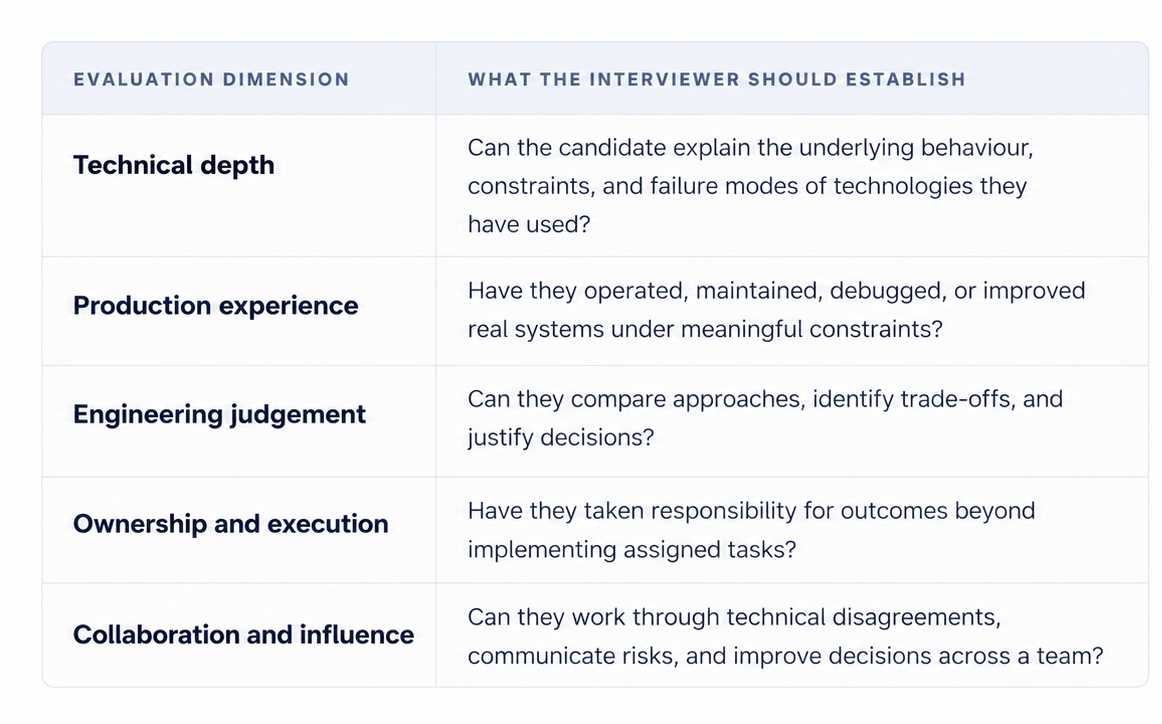
Can they work through technical disagreements, communicate risks, and improve decisions across a team?
These dimensions are related, but they are not interchangeable.
A technically strong individual contributor may have limited experience owning production outcomes. An engineer who communicates confidently may not have the technical depth required for a particular architecture. And a candidate with significant production experience may still struggle to make decisions outside familiar environments.
The objective is not to find someone who scores perfectly on every dimension. It is to determine whether their strengths, limitations, and demonstrated experience align with the responsibilities of the position.
One of the most revealing technical interview questions is also one of the simplest.
Interview Question 01 — Project Deep Dive
"Walk me through a system you personally helped design or build. Start with the business problem, explain the important technical decisions, and tell me what changed after it went into production."
This is more valuable than asking candidates to describe an ideal system architecture from scratch.
Why?
Because real systems come with constraints.
There are deadlines, existing infrastructure, imperfect requirements, team limitations, and decisions inherited from previous engineers. The ability to work effectively within these constraints is central to senior engineering.
Suppose the candidate describes building a payment-processing service.
A strong answer might explain the transaction volume and reliability requirements at the time, why the team selected a particular architecture, which components the candidate personally designed, and how duplicate requests, retries, and partial failures were handled.
They should also be able to explain what changed as transaction volume increased and which decisions they would reconsider with hindsight.
Notice what makes the answer valuable.
It is not the number of technologies mentioned. It is the relationship between requirements, decisions, implementation, and outcomes.
"We used Java, Spring Boot, Kafka, Redis, PostgreSQL, and Kubernetes. It was a microservices architecture that handled high traffic."
This answer is not necessarily incorrect. But it tells the interviewer very little about the candidate's contribution or judgement.
The interviewer should follow up:
The final question is particularly useful.
An experienced engineer should be capable of recognising when a technically sophisticated solution is unnecessary.
Consultant's perspective: System scale provides context. It does not, by itself, establish individual capability. An engineer who made thoughtful decisions in a smaller production environment may be more suitable for a scaling startup than someone who contributed narrowly to a much larger system.
Writing new code and diagnosing a failing production system require overlapping but different skills.
In a coding exercise, the problem is usually defined. The inputs are known, the expected output is clear, and the candidate can concentrate on implementation.
Production failures are rarely that convenient.
A service may become slow without a deployment. A database may experience intermittent connection failures. An API may return errors only for certain customers.
Senior engineers need to reason through uncertainty.
Interview Question 02 — Production Debugging
"Your application normally responds within 150 milliseconds. Over the past 30 minutes, the p95 response time has increased to 2.5 seconds. Error rates are mostly unchanged, and there has been no recent application deployment. How would you investigate?"
Do not expect a single correct answer. Instead, observe how the candidate structures the investigation.
Less mature response
"I would check the logs, restart the service, increase the number of instances, and see if the performance improves."
These actions might be useful in specific circumstances, but the answer lacks a diagnostic approach.
Stronger response
"I would first establish the scope of the degradation. Is it affecting all endpoints, particular customers, or specific regions? Then I would compare latency, traffic, saturation, database performance, and downstream dependency metrics against the normal baseline.
I would also look for changes outside application deployments, such as traffic patterns, database plans, infrastructure events, or dependency behaviour.
If customers are significantly affected, I would consider a safe mitigation while continuing the investigation, rather than immediately introducing a permanent fix."
This answer demonstrates several useful behaviours.
The candidate separates symptoms from causes, investigates before making changes, considers customer impact, and distinguishes immediate mitigation from root-cause resolution.
The most valuable signal is not whether the candidate names every possible diagnostic tool. It is whether they can build and test hypotheses systematically.
A candidate who immediately recommends adding more servers may be addressing a symptom without understanding the cause. A candidate who insists on completing root-cause analysis before taking any mitigating action may underestimate the operational urgency.
Strong production engineers understand that restoring service and identifying the underlying problem are related but separate responsibilities.
System design interviews are widely used for senior engineering roles.
Unfortunately, they can become exercises in reproducing familiar architecture patterns.
Ask candidates to design a large-scale application, and many will quickly introduce a load balancer, API gateway, microservices, message queue, caching layer, and multiple databases.
The resulting diagram may look convincing.
But architectural maturity is not measured by the number of components someone can draw. It is measured by whether the proposed design fits the problem.
Imagine you are hiring a senior engineer for a growing B2B SaaS company.
Interview Question 03 — Architecture Judgement
The company has the following characteristics:
"Would you recommend moving to microservices? Explain your decision."
A weak response might be:
"Yes. Microservices will make the application more scalable and allow teams to deploy independently."
That statement describes potential benefits, but it does not establish whether the migration is justified.
A stronger candidate will investigate the problem before recommending a solution.
They might ask whether slow deployments are caused by the architecture or by CI/CD and testing practices. They might investigate whether performance bottlenecks are concentrated in particular modules, whether those workloads can be isolated without splitting the application, and whether the engineering team has the operational maturity to manage distributed services.
The candidate might ultimately recommend retaining the monolith while improving module boundaries, deployment pipelines, observability, and workload isolation.
Or they might recommend extracting one particularly constrained service.
Either recommendation could be appropriate if supported by evidence.
"What would make your recommendation wrong?"
This is a powerful test of engineering judgement.
Strong engineers can identify the assumptions behind their decisions. They recognise that architecture is rarely about choosing between an obviously correct and an obviously incorrect option.
It is about selecting an acceptable trade-off under specific constraints.
An engineer who cannot explain when their preferred solution would fail may not fully understand its limitations.
Ownership is one of the most frequently mentioned requirements in senior engineering job descriptions. It is also one of the least consistently evaluated.
Candidates often say they "owned" a service, "led" a migration, or "managed" a critical feature. However, these statements can represent very different levels of responsibility. One engineer may have implemented assigned tickets within an established architecture, while another may have defined the technical approach, coordinated dependencies, handled production issues, and remained accountable for the outcome after deployment.
Both engineers may have contributed to the same project. Both may legitimately include it on their resumes. But their experience is not necessarily equivalent, and the difference becomes important when hiring someone expected to make independent technical decisions.
Instead of asking candidates to describe their responsibilities, ask them to explain a consequential decision they personally made.
Interview Question 04 — Ownership
"Tell me about an important technical decision you personally made that did not work as expected. What happened, and what did you do afterward?"
A strong answer should establish four things: the original decision context, the candidate's personal contribution, the consequences of the decision, and the corrective actions that followed.
Consider an engineer who introduced an aggressive caching strategy to reduce database load. Initially, the change improved response times and reduced pressure on the database. However, after deployment, certain customers began receiving stale information because the invalidation strategy did not account for a particular update workflow.
A candidate with meaningful ownership should be able to explain how the problem was identified, how customer impact was contained, and why the original assumptions proved incomplete. They should also be able to discuss whether the team changed its invalidation approach, introduced additional monitoring, or improved the testing process to prevent similar failures.
The value of this discussion is not that the engineer made a mistake. Most engineers who have worked on sufficiently complex systems have encountered decisions that did not produce the expected outcome.
What matters is whether they understand the consequences of their decisions and can demonstrate how that experience improved their engineering judgement.
Interviewers should also be careful not to reward candidates simply because they describe their achievements confidently.
Some candidates naturally present team accomplishments as individual successes. Others are more deliberate about acknowledging colleagues, architectural constraints, and decisions made by engineering leadership.
The second group should not be disadvantaged for accurately describing collaborative work.
A better approach is to ask candidates which decisions they personally influenced, what alternatives they considered, and what would have happened if they had not been involved.
Ownership is not about claiming credit for everything that happened. It is about understanding one's responsibility for the decisions and outcomes that mattered.
Engineering decisions rarely happen in an environment where time, budget, resources, and technical capacity are unlimited.
A technically ideal solution may be commercially inappropriate. Conversely, an implementation that satisfies an immediate delivery deadline may introduce operational risks that the organisation cannot reasonably accept.
Senior engineers are expected to navigate these competing priorities. They need to understand not only what is technically possible, but also which compromises are acceptable given the business context.
Interview Question 05 — Engineering Trade-offs
Your company is preparing to launch an enterprise feature. The product team wants it delivered in eight weeks, but the engineering team estimates that a fully scalable implementation will require approximately 14 weeks.
"You are the senior engineer responsible for this feature. How would you approach the situation?"
One candidate might respond by insisting that the deadline be extended because quality cannot be compromised. Another might suggest increasing working hours or adding more engineers to meet the original commitment.
Neither answer is necessarily sufficient. The first assumes that the proposed technical implementation is the only acceptable solution. The second assumes that additional effort can resolve the underlying constraints without introducing new risks.
A stronger candidate would begin by understanding why the eight-week deadline matters. Is it tied to a contractual commitment, an enterprise customer rollout, a competitive requirement, or an internal business objective?
That context changes the engineering conversation.
The candidate might propose reducing the initial scope, releasing the feature to a limited customer group, deferring non-critical functionality, or implementing a simpler architecture that can evolve as adoption increases. They should also recognise which requirements cannot be compromised, particularly those involving security, data integrity, regulatory obligations, or contractual commitments.
The important distinction is between decisions that are relatively easy to reverse and those that create long-term constraints.
For example, delivering a limited reporting interface in the first release may be acceptable if the underlying data model can support future improvements. Introducing a data model that risks corrupting customer records is a fundamentally different compromise.
A strong candidate should be able to translate technical concerns into options that product and business stakeholders can evaluate.
Rather than simply stating that a feature will take 14 weeks, they should be capable of explaining what could reasonably be delivered in eight weeks, what would need to be deferred, and what risks would accompany each alternative.
This does not mean that senior engineers should accept every business deadline. In some situations, the responsible recommendation will be to delay the release.
But that recommendation should emerge from a clear assessment of constraints, consequences, and alternatives rather than an inflexible preference for a particular technical solution.
Engineering maturity becomes visible when someone can balance delivery expectations with technical responsibility without treating either as unimportant.
One of the mistakes organisations make when evaluating senior engineers is assuming that leadership capability must be demonstrated through formal management experience.
Not every senior engineer needs to become an engineering manager. In many organisations, experienced individual contributors create substantial value by improving architecture, mentoring other engineers, reviewing complex technical decisions, and establishing better engineering practices.
Their influence may extend across multiple teams even when they have no direct reports.
For this reason, technical leadership should be evaluated separately from people management.
Interview Question 06 — Technical Influence
"Tell me about a time you disagreed with another senior engineer or your engineering manager on a technical decision. How did you resolve it?"
The objective is not to determine whether the candidate won the disagreement. It is to understand how they approached a situation where capable engineers held different views.
A less mature candidate might describe escalating the disagreement immediately or continuing to argue until their preferred approach was accepted.
A stronger candidate should be able to explain the technical concerns behind the disagreement, what evidence was considered, and how the team eventually reached a decision.
For example, two engineers might disagree about introducing an asynchronous processing layer. One may believe it is necessary to improve responsiveness and isolate workloads, while the other may be concerned about operational complexity, eventual consistency, and debugging challenges.
The most useful interview discussion is not about which engineer was correct in the abstract. It is about how the candidate evaluated the competing concerns, what evidence they used, and whether they were willing to change their position when new information emerged.
It is equally important to understand what happened after the decision was made.
Did the candidate support the agreed approach even when it was not their preferred option? Did they help validate assumptions during implementation? Were they able to revisit the decision constructively when circumstances changed?
Technical leadership requires the ability to challenge ideas without turning every disagreement into a contest. It also requires knowing when to stop debating and help the team move forward.
The strongest senior engineers do not simply contribute good technical ideas. They help engineering teams make better technical decisions.
A well-designed senior engineering interview does not need to cover every programming language, framework, database, or architecture pattern a candidate has encountered.
Attempting to assess everything in a single conversation often produces superficial evidence across too many areas. The interviewer may leave with an impression of the candidate's technical familiarity without understanding whether they can handle the responsibilities of the role.
A more effective approach is to organise the evaluation around a smaller number of capabilities and examine each through relevant examples.
For a senior backend or full-stack engineering position, the following 60-minute structure provides a practical starting point.
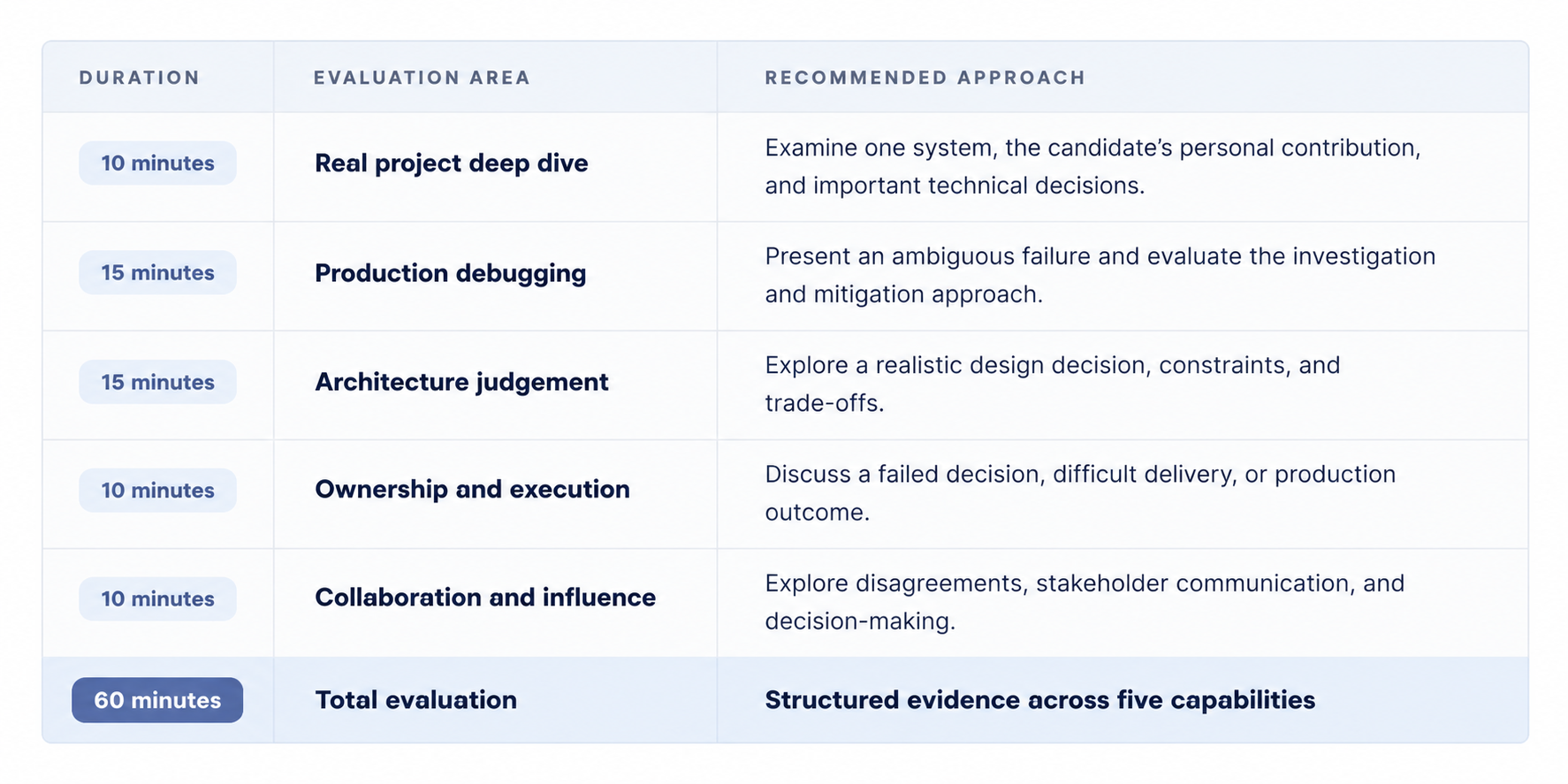
This framework is intended to complement, not replace, other relevant assessments.
A role requiring substantial hands-on implementation should still include an appropriate coding exercise, code review, or work-sample assessment. Similarly, a position involving specialised infrastructure, security, machine learning, or low-latency systems will require additional domain-specific evaluation.
The objective is not to eliminate technical testing. It is to ensure that the interview process evaluates capabilities that are particularly important at senior levels.
One of the difficulties in engineering interviews is that different interviewers often assess candidates against different standards.
An engineering manager may place significant weight on architecture discussions. A senior developer may focus on coding quality and technical fundamentals. Another interviewer may be particularly influenced by communication style or previous company experience.
All of these perspectives can contribute useful information, but without a common evaluation framework, hiring decisions can become difficult to compare and justify.
A structured scoring model helps establish which capabilities matter, how much weight they should receive, and what evidence interviewers should collect.
Evaluation dimensionSuggested weightTechnical depth25%Production debugging and reliability20%Architecture and engineering judgement25%Ownership and execution20%Collaboration and influence10%Total100%
These weights are illustrative rather than universal benchmarks. A platform engineering role may require greater emphasis on production reliability, while a senior engineer joining a small product team may need a broader balance of technical execution, ownership, and collaboration.
The scoring model should reflect the responsibilities of the actual position.
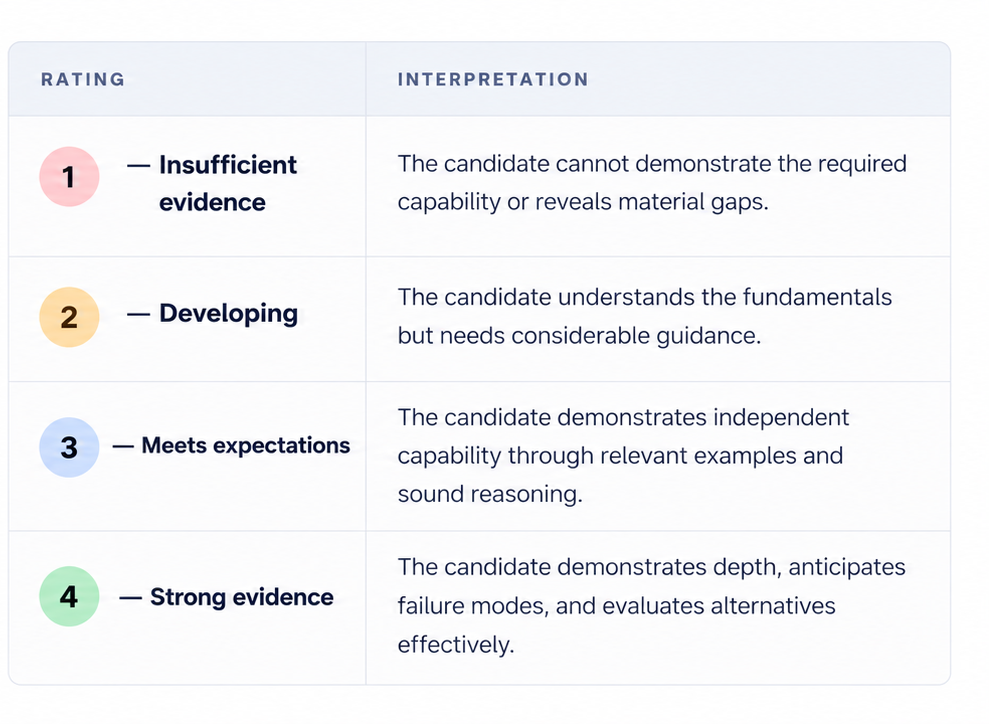
The candidate demonstrates depth, anticipates failure modes, and evaluates alternatives effectively.
A numerical score should never become a substitute for engineering judgement.
Interviewers should document the evidence behind each rating, distinguish missing evidence from demonstrated weakness, and identify any critical capability that requires further assessment.
A candidate might perform exceptionally well in architecture discussions but have limited experience operating production systems. For a role focused on platform reliability, that gap could be significant even if the candidate's overall weighted score appears strong.
This is also why a technically informed assessment process matters. In engineering hiring, the challenge is not simply identifying candidates who match a technology stack, but establishing whether their practical experience and engineering judgement align with the responsibilities they will be expected to own.
The more clearly these expectations are defined, the more useful the evaluation becomes for both the hiring team and the candidate.
Experienced interviewers often notice certain patterns that warrant additional questioning. These should not be treated as automatic rejection criteria, because interview performance can be influenced by unfamiliarity with the format, communication differences, or the candidate's previous working environment.
However, when explored carefully, these patterns can reveal important gaps between stated experience and demonstrated capability.
Engineering decisions rarely involve only one reasonable approach. Even when a particular solution ultimately proves successful, alternatives usually exist, and the chosen design typically introduces some trade-offs.
If a candidate describes every architecture decision as straightforward, ask what alternatives were considered, why they were rejected, and which risks the team accepted.
The concern is not that the candidate made a confident decision. It is that they may not have considered the constraints and consequences behind it.
Complex production incidents often involve multiple services, teams, and dependencies. It would be unreasonable to expect every engineer to have personally caused or prevented every issue they encountered.
However, a senior engineer should be able to discuss how they contributed to diagnosis, mitigation, communication, or prevention.
If every incident is described entirely as another team's failure, the interviewer should investigate whether the candidate understands shared operational responsibility.
A candidate who recommends Kafka, Kubernetes, or microservices before understanding the requirements may be relying on familiar architecture patterns rather than evaluating the actual problem.
This is particularly relevant when hiring engineers for growing organisations, where unnecessary infrastructure complexity can consume significant engineering capacity.
A useful follow-up is to ask the candidate what conditions would justify a simpler alternative.
Statements such as "we improved performance" or "we made the system scalable" are difficult to evaluate without additional context.
An experienced interviewer should ask what changed, how the improvement was measured, what limitations remained, and whether the implementation introduced new operational costs.
Not every project will have precise before-and-after metrics. But candidates should still be capable of explaining the outcomes and trade-offs of important decisions.
Engineering is collaborative by nature. Successful projects usually involve several people contributing to design, implementation, testing, deployment, and maintenance.
The purpose of an interview is not to minimise that collaboration. It is to establish what the candidate personally contributed within it.
When a candidate repeatedly describes what "we" accomplished, ask which decisions they owned, which parts they implemented, and where they influenced the outcome.
The answers often reveal more about seniority than the project description itself.
In many organisations, the underlying problem is not a shortage of interview rounds. It is a lack of clarity about what each round is expected to establish.
A candidate may complete an online coding assessment, two technical interviews, a system design discussion, and a final hiring manager conversation. Yet the hiring team may still be uncertain about whether that person has handled meaningful production incidents, made independent architectural decisions, or demonstrated ownership in difficult engineering situations.
This happens when interview stages are designed around familiar activities rather than specific hiring decisions.
For example, an organisation may include a system design interview because senior engineers are generally expected to understand system design. But unless the interviewer knows which architectural capabilities matter for the role, the discussion may reward candidates who are familiar with popular interview patterns rather than those who can solve the company's actual engineering problems.
Adding another interview round does not necessarily address this weakness. It may simply create more work for the candidate and the engineering team while producing similar evidence.
A better approach begins before the first candidate is interviewed.
Job descriptions frequently emphasise years of experience, programming languages, frameworks, and previous company backgrounds. These details help identify potentially relevant candidates, but they do not fully explain the work the engineer will be expected to perform.
Consider the difference between requiring "eight years of Java experience" and looking for someone who can "own the reliability and evolution of payment-processing services while supporting increasing transaction volumes."
The second description gives the hiring team a clearer basis for evaluation. It identifies an engineering outcome rather than simply a technology requirement.
A startup hiring its first senior backend engineer may require someone who can independently handle architecture, implementation, deployment, and operational troubleshooting.
A larger organisation hiring into a specialised platform team may prioritise deeper expertise in a narrower technical domain, supported by established engineering processes and dedicated infrastructure teams.
Both positions may have the same title, but their evaluation requirements should differ.
When hiring teams fail to establish these distinctions, they risk selecting candidates who are technically capable but poorly aligned with the actual working environment.
Once the responsibilities are clear, the interview process should be designed around them.
If production reliability is essential, include realistic debugging scenarios. If architectural decisions are central to the role, explore technical trade-offs. If the engineer will coordinate across teams, assess how they communicate disagreements, manage dependencies, and influence decisions.
This alignment between role expectations and interview evidence is more important than the number of interviews conducted.
The purpose of technical evaluation is not to prove that a candidate knows engineering. It is to establish whether they can perform the engineering work the organisation needs.
The cost of an unsuccessful senior engineering hire is often discussed in terms of recruitment expenses, compensation, and the time required to find a replacement.
Those costs matter, but they do not capture the full engineering impact.
A senior engineer is frequently entrusted with decisions that influence the work of several other people. Their architectural choices can shape future development, their approach to production incidents can affect system reliability, and their technical recommendations can determine how engineering resources are allocated.
When someone lacks the judgement or experience required for the position, the consequences may extend beyond their individual performance.
An unnecessarily complex architecture can increase infrastructure and maintenance costs. Poorly understood dependencies can make production incidents harder to resolve. Weak technical decisions can introduce rework that other engineers must absorb months after the original implementation.
There is also a less visible opportunity cost.
When a senior engineer cannot independently handle the responsibilities expected of the role, engineering managers and staff engineers often compensate by spending more time reviewing decisions, troubleshooting implementations, or providing repeated technical direction.
That time comes at the expense of other responsibilities, including architecture planning, mentoring, delivery improvements, and long-term engineering strategy.
The impact is not always immediate. An engineer may appear productive during the first few months because they are delivering assigned work. The mismatch may only become apparent when they are expected to own a complex system, resolve an unfamiliar production issue, or make a consequential technical decision without close supervision.
These costs are difficult to measure precisely and vary significantly between organisations. Nevertheless, they explain why senior engineering hiring deserves the same level of technical discipline applied to other important engineering decisions.
The objective should not be to make interviews unnecessarily difficult or to search for candidates who have encountered every possible technical problem.
It should be to reduce uncertainty about whether the candidate can operate effectively at the level of responsibility the position requires.
A strong senior engineering hire should increase the team's ability to make and execute sound technical decisions, not simply increase the amount of code being written.
Improving senior engineering evaluation does not require abandoning coding assessments, introducing excessive interview rounds, or expecting every candidate to have experience with large-scale distributed systems.
It requires a more deliberate connection between the role being hired for, the evidence collected during evaluation, and the decision the organisation ultimately needs to make.
The process should begin with a clear understanding of the engineering environment. What systems will the candidate work on? What decisions will they make independently? What level of production responsibility will they carry? Which problems should they already have experience solving, and which capabilities can reasonably be developed after joining?
These questions should inform the hiring brief before sourcing begins.
Once the role is defined, the evaluation should establish an appropriate technical baseline. This may involve a coding exercise, a code review, or a practical work sample depending on the position. The purpose is to confirm that the candidate has the hands-on capabilities required for the work, without allowing one assessment format to dominate the entire hiring decision.
The next stage should investigate real experience. Rather than moving rapidly between unrelated technical questions, interviewers should examine a smaller number of meaningful projects in sufficient depth to understand the candidate's decisions, contributions, and outcomes.
Realistic scenarios can then be used to evaluate how the candidate approaches unfamiliar problems. Production incidents, architecture choices, delivery constraints, and technical disagreements provide useful opportunities to observe reasoning rather than simply test recall.
Finally, the hiring team should compare the evidence against predefined criteria. This helps distinguish a candidate who performs confidently in an interview from someone who has demonstrated the capabilities needed for the role.
The sequence matters because technical evaluation cannot compensate for an unclear hiring requirement.
If the organisation has not established what success looks like, even a technically rigorous interview may produce the wrong hiring decision.
This becomes particularly important when companies are hiring several engineers simultaneously. Without consistent expectations and evaluation criteria, different interviewers may apply different standards, resulting in repeated interviews, delayed decisions, and avoidable use of engineering capacity.
A stronger process creates alignment between recruitment, engineering leadership, and the people conducting technical assessments.
It also recognises that hiring is a shared responsibility. Recruiters contribute expertise in sourcing, candidate engagement, talent markets, and process management. Engineering leaders contribute the technical context required to evaluate capability, experience, and judgement.
Neither discipline needs to replace the other.
The strongest hiring processes combine them in a way that produces better evidence earlier, while reserving internal engineering time for candidates who have a credible chance of succeeding in the role.
Ultimately, the objective is not simply to identify candidates who can pass technical interviews.
It is to identify engineers who can succeed in the environment they are being hired into.
A coding test can show whether an engineer can solve a defined problem. A technical discussion can establish whether they understand a particular technology. A project walkthrough can provide evidence of the systems they have worked on and the responsibilities they have handled.
All of these assessments have value.
But senior engineering effectiveness is often demonstrated in situations that are less predictable.
It becomes visible when a production system fails without an obvious cause, when architectural choices involve difficult trade-offs, when a deadline conflicts with technical risk, or when an engineering team needs someone to make a decision without having every answer.
These are the situations in which experience becomes valuable, and they are precisely the situations that conventional technical interviews can overlook.
The goal should not be to find an engineer who has memorised the most concepts, worked with the largest number of technologies, or produced the most impressive system design diagram.
It should be to understand whether the candidate has the technical foundations, practical experience, ownership, and judgement required to make good decisions in the organisation's actual engineering environment.
That requires looking beyond the resume, beyond technology checklists, and beyond the outcome of a single coding exercise.
Because ultimately, the most important question in a senior engineering interview is not simply:
"Can this person build it?"
It is:
"Can we trust this person to make sound engineering decisions when the right answer is not obvious?"
That is the standard against which senior engineering talent should be evaluated.
Identifying the right engineering talent requires more than matching technical skills. ProfoundIQ combines targeted sourcing with technical evaluation by former CTOs and experienced engineering leaders, helping companies make more informed hiring decisions while reducing the screening burden on their engineering teams.
Discuss Your Hiring Requirement