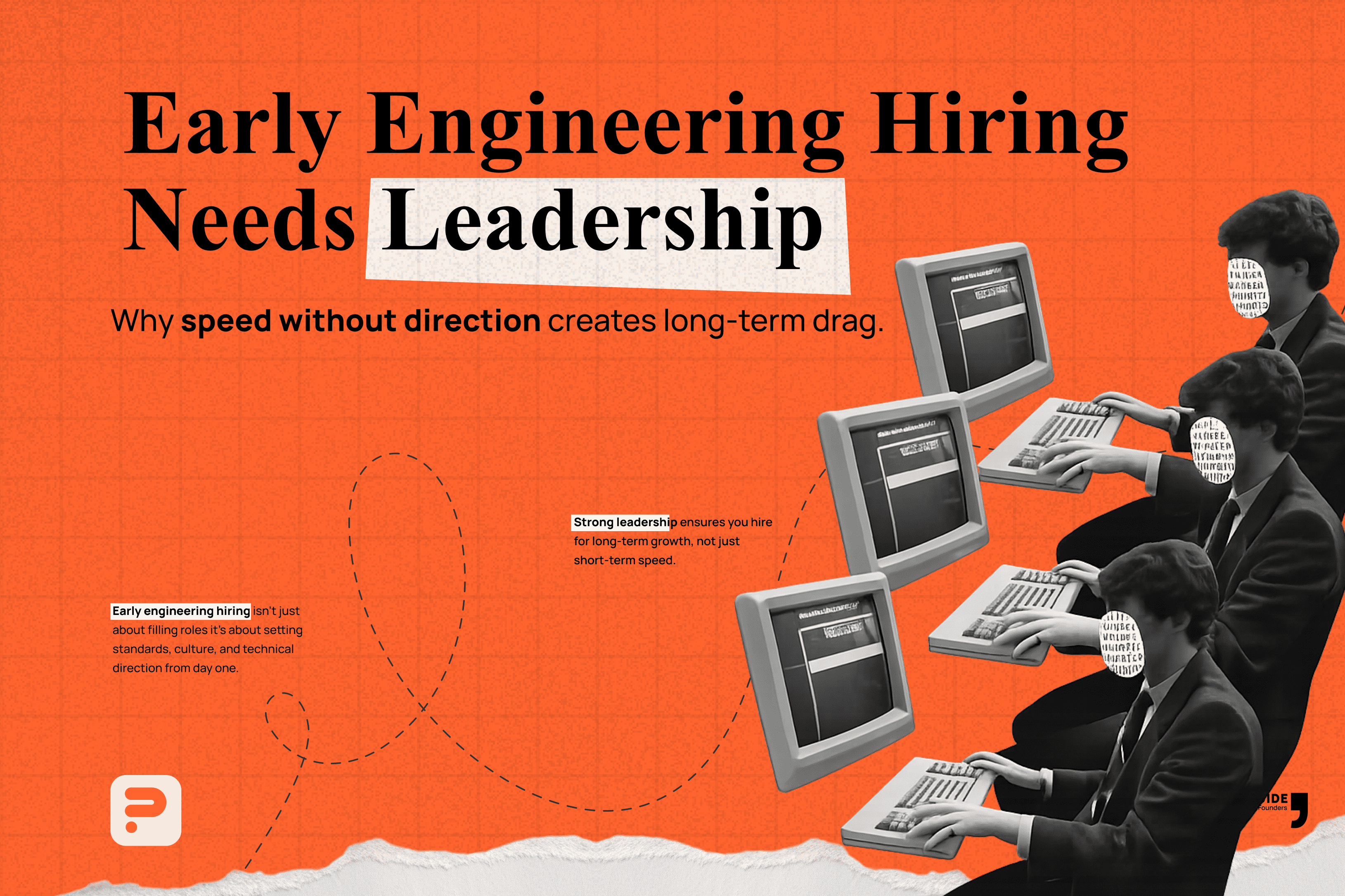
Early engineering hiring is often treated as a recruiting exercise. Job descriptions are drafted, candidates are screened, and roles are filled as quickly as possible to support delivery timelines. In many organizations, these decisions are driven primarily by hiring processes rather than technical leadership.
This approach is understandable, but it is also one of the most common reasons engineering teams struggle later.
Early engineering hiring is not just about bringing people into the organization. It is about deciding how technology will be built, how decisions will be made, and how systems will evolve as the business grows. These are technical leadership decisions, not hiring logistics.
When early engineering hiring is led without strong technical leadership involvement, the consequences rarely show up immediately. They surface later as technical debt, slow execution, unclear ownership, and teams that struggle to scale.
The first few engineering hires influence architecture, tooling, development practices, and delivery standards. Even when these decisions feel temporary, they quickly become embedded in the system.
Without senior technical leadership guiding these choices, early hires are forced to make system-level decisions on their own. They choose tools based on familiarity, design solutions around immediate needs, and optimize for speed without full visibility into long-term impact.
This is not a failure of effort or intent. It is a leadership gap.
Technical leadership provides the context engineers need to make good decisions. It defines what matters now, what can wait, and what should not be built yet. Without that guidance, early engineering hiring sets direction by accident rather than design.
HR and recruiting teams play a critical role in identifying talent, managing hiring processes, and ensuring fair and efficient recruitment. However, they are not responsible for owning technical outcomes.
Early engineering hiring decisions require answers to questions such as:
These questions cannot be answered through resumes or interviews alone. They require senior technical judgment.
When hiring decisions are made without that judgment, companies often hire engineers who are capable individually but misaligned with the technical direction the business actually needs.
One of the reasons this problem persists is that early engineering hiring mistakes rarely fail loudly.
Teams deliver features. Products ship. Progress appears steady. The absence of technical leadership does not immediately block execution.
The cost shows up later as:
At that point, companies often attempt to fix the problem by hiring more engineers or replacing individuals. In reality, the root cause is that early hiring decisions were made without leadership shaping the technical environment.
Strong engineering teams are not defined by how hard they work. They are defined by the quality of decisions made under constraint.
Senior technical leadership brings clarity around priorities, architecture, and accountability. It ensures that early engineering effort supports business goals rather than creating future friction.
Without this leadership, engineers are expected to balance delivery pressure with long-term decision-making responsibilities they were never meant to own. Even highly capable engineers struggle in this environment.
This is not an execution issue. It is a leadership issue.
Some organizations attempt to address leadership gaps by hiring more senior engineers early. While experience helps, it does not replace leadership.
Senior engineers still need alignment, decision ownership, and clear direction. Without it, systems fragment as individual preferences and past experiences shape decisions independently.
Leadership must guide hiring. Hiring cannot substitute for leadership.
When early engineering hiring is led by technical leadership, the outcome changes.
Hiring becomes intentional rather than reactive. Roles are defined based on real needs, not urgency. Engineers join a system with clear expectations, standards, and ownership.
This leads to fewer hiring mistakes, stronger alignment, and teams that scale with confidence instead of friction.
The long-term cost of getting this wrong is rarely immediate failure. It is slow erosion. Progress becomes harder. Risk accumulates quietly. Teams spend more time managing the past than building the future.
Early engineering hiring is one of the most consequential decisions a company makes. Treating it as a recruiting task undervalues its impact.
When technical leadership drives early hiring decisions, technology becomes a foundation for growth. When it does not, companies spend years correcting decisions that could have been avoided.
For organizations that depend on technology, early engineering hiring must be led by technical leadership if long-term success is the goal.
.png)