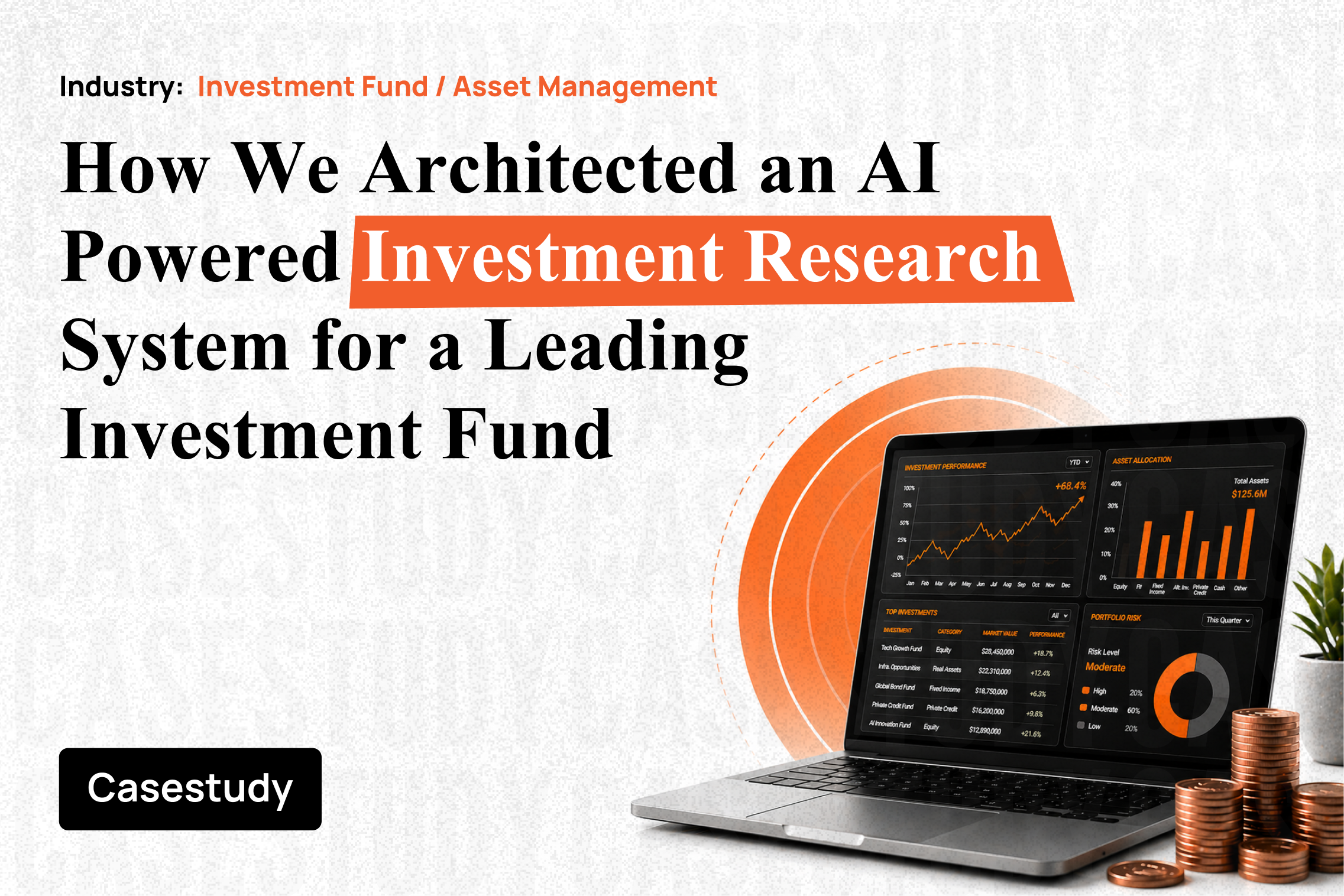
A leading investment fund focused on building a data-driven investment strategy across traditional and alternative asset classes.
As the fund expanded its research scope, it began working with a growing volume of structured and unstructured data sources including market data platforms, alternative datasets, research reports, and open data sources. However, research workflows remained heavily manual and fragmented across tools and teams.
Analysts were required to spend significant time gathering, validating, and synthesizing information, which limited both speed and scale of investment decision-making.
Build an AI powered investment research system that centralizes multi-source data, enables intelligent analysis, reduces dependency on manual workflows, and creates a scalable research infrastructure for long-term growth.
As research complexity increased, several structural limitations became evident.
Data was fragmented across multiple platforms including Bloomberg, alternative datasets, news sources, and internal research documents. There was no unified system to ingest, normalize, and analyze this data in a consistent manner.
Analysts were manually synthesizing large volumes of structured and unstructured information, leading to slow turnaround times and inconsistent outputs. Institutional knowledge was not centrally captured, making it difficult to reuse insights across teams.
The research process also lacked a systematic way to triangulate signals across financial data, sector trends, and qualitative narratives. This increased dependency on individual analysts and limited the ability to scale research coverage.
Operational costs continued to rise due to analyst-heavy workflows, while the demand for faster, data-backed decision-making kept increasing.
Through fractional CTO leadership and AI system design, we architected a unified investment intelligence platform tailored to the fund’s research workflows.
We built a centralized data ingestion and normalization framework capable of consuming data from multiple sources including market data platforms, alternative datasets, and internal knowledge repositories. This created a consistent and scalable data foundation.
On top of this, we implemented a retrieval-based intelligence layer that enabled contextual querying across all data sources. This allowed analysts to access relevant insights quickly while preserving source attribution and improving reliability.
Agentic research workflows were designed to automate multi-step analysis such as sector comparisons, signal triangulation, and thesis generation. These workflows reduced manual effort while improving consistency in research outputs.
We also structured an institutional knowledge repository to capture insights, research outputs, and historical analysis, enabling long-term knowledge compounding.
The system was integrated directly into the fund’s existing research processes, ensuring seamless adoption without disrupting ongoing workflows.
The implementation significantly improved research efficiency, scalability, and decision-making capabilities.
The fund successfully transitioned from a manual, analyst-constrained research model to a scalable, AI powered investment research system.
With a unified data foundation and intelligent research workflows, the organization is now able to process and analyze significantly larger volumes of data with greater speed and accuracy.
Analysts can focus on high-value decision-making rather than manual data gathering and synthesis. At the same time, institutional knowledge is continuously captured and reused, strengthening long-term research capabilities.
The fund now operates with a compounding intelligence advantage, supported by a scalable research infrastructure that is designed to grow alongside its investment strategy.