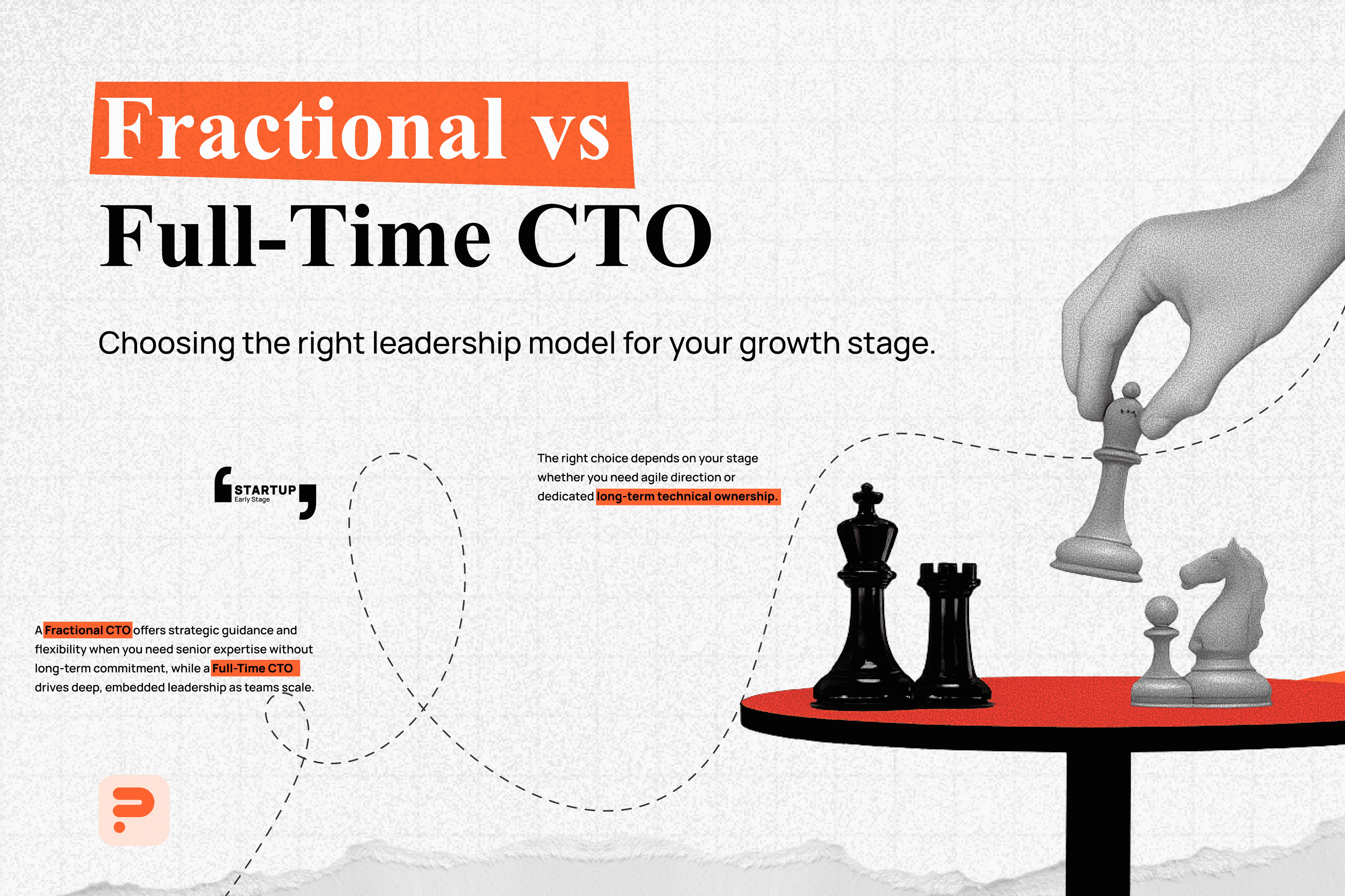

When founders first hear the term fractional CTO, the most common association is cost. It is often perceived as a cheaper alternative, a temporary workaround, or something pursued when hiring a full-time CTO feels premature or out of reach.
That framing, however, is not only incomplete, it is misleading.
For high-performing startups, a fractional CTO is not a compromise around leadership. It is a deliberate strategy to deploy senior technical judgment exactly where it creates the highest leverage. When applied intentionally, fractional CTO leadership improves decision quality, reduces long-term technical and organizational risk, and accelerates execution without forcing the company into a leadership structure it may quickly outgrow.
The real distinction is not cost. It is how, when, and why technical leadership is applied.
Startups rarely fail because they spend too little on technology leadership. More often, they fail because leadership investment is made at the wrong time, in the wrong form, or with the wrong expectations.
Optimizing the CTO decision purely around salary frequently leads to false economies. The consequences do not appear immediately. They surface later as architectural rewrites, delayed delivery, scaling bottlenecks, team churn, and missed market windows. By the time these issues are visible, they are already expensive to fix.
Fractional CTOs are often positioned as a stopgap until a company can afford a “real” CTO. In reality, many of the most consequential technical decisions are made long before a full-time CTO would be effective or even necessary.
Early choices around system architecture, technology stacks, build-versus-buy decisions, hiring profiles, and product boundaries carry long-term implications that compound over time. These are not execution problems. They are judgment problems.
And judgment does not require permanent presence. It requires experience.
Fractional CTO leadership is not abstract advisory support. It is operational leadership applied selectively.
Its value lies in experience, pattern recognition, and the ability to frame decisions correctly at moments where mistakes compound. A strong fractional CTO does not simply answer technical questions. They help founders ask the right ones in the first place.
At early and transitional stages, startups rarely need someone managing engineers full time. What they need is senior leadership that can translate business objectives into technical direction.
This includes making intentional architectural trade-offs, identifying risks before they become visible failures, guiding early hiring and team structure, and creating alignment between product, engineering, and business leadership.
This work is inherently strategic and episodic. It benefits far more from depth of experience than from volume of hours, which is why fractional leadership aligns so naturally with early-stage realities.
One of the most misunderstood aspects of technical leadership is involvement. Founders often assume that leadership value scales linearly with time spent.
In practice, leadership value scales with timing and context.
A full-time CTO model assumes constant presence is the primary requirement. This becomes true at later stages, when organizations are larger, execution complexity increases, and culture must be reinforced daily.
Earlier on, however, the highest leverage comes from leadership involvement at critical decision points rather than from continuous oversight.
Fractional CTO models concentrate senior involvement around irreversible or high-impact decisions such as architecture definition, platform evolution, hiring inflection points, and scale-readiness planning. This ensures that experience is applied where it materially changes outcomes, rather than diluted across operational noise.
Many early technical failures are not execution problems at all. They are leadership failures in disguise.
Teams may move quickly, but without a clear technical direction. Systems often evolve organically, but without architectural coherence. Hiring decisions prioritize short-term speed over long-term fit.
Over time, these patterns accumulate into fragmented systems, unclear ownership, and growing complexity.
A fractional CTO helps founders avoid these traps by introducing structure without slowing momentum. The objective is not to impose heavyweight process or enterprise thinking prematurely.
Instead, the goal is to create just enough clarity to prevent costly detours.
This includes deciding what not to build yet, which problems can safely be deferred, where technical debt is acceptable, and when specialist hires make sense versus generalists. Frequently, these decisions deliver more long-term value than shipping additional features because they protect future velocity.
The more useful question is not which model is better, but which model fits the current stage of the company.
A full-time CTO is designed for long-term ownership, organizational continuity, deep team management, and culture building at scale. A fractional CTO is designed for focus, leverage, and decision quality during periods of uncertainty or transition.
Both models are valid, and both can produce strong outcomes. Problems arise only when founders default to one model without evaluating fit.
High-performing startups treat leadership structure as something that evolves. They revisit it as the company moves from idea to MVP, from MVP to early traction, and from traction to scale.
Fractional leadership often plays a critical role during these transitions, either before a full-time CTO is hired or alongside one.
Budget constraints are real, but they should not drive leadership decisions in isolation.
Hiring a full-time CTO too early because it feels like a milestone can be just as risky as avoiding senior leadership to save money. In both cases, the underlying issue is misalignment between structure and stage.
Fractional CTO leadership allows startups to access senior expertise without committing to a permanent organizational structure that may not yet fit. This flexibility preserves runway while improving decision quality.
Seen this way, fractional leadership is not a cost optimization. It is a risk optimization.
And risk management is one of the core responsibilities of effective technical leadership.
From an investor perspective, early technical leadership decisions signal how founders think about leverage, discipline, and long-term value creation.
A startup that applies senior judgment intentionally, rather than hiring for optics or titles, often demonstrates stronger strategic maturity.
Fractional CTO involvement can increase investor confidence when it results in clear and scalable architecture, realistic delivery roadmaps, thoughtful hiring plans, and transparent technical trade-offs.
Ultimately, what matters is not the title on a business card, but the quality of decisions being made behind the scenes.
Fractional leadership is not a permanent solution for every company.
As teams grow and execution complexity increases, leadership presence becomes more critical. Cultural consistency, mentorship, and long-term ownership benefit from full-time involvement.
The mistake is not transitioning away from fractional leadership. The mistake is assuming that full-time leadership should exist before the organization is ready to support it.
High-performing companies make this transition deliberately rather than reactively.
The strongest founders do not view fractional CTOs as placeholders.
They view them as a leadership model optimized for a specific phase of growth. They engage senior expertise early, apply it where it matters most, and evolve their leadership structure as the company matures.
Fractional CTO leadership works best when the scope is clearly defined, expectations are aligned, and success is measured by outcomes rather than activity.
When treated this way, it delivers impact comparable to full-time leadership without the rigidity.
A fractional CTO is not a compromise. It is a strategic choice.
For startups navigating uncertainty, rapid change, and constrained resources, the ability to apply senior technical judgment precisely when it matters most can be a decisive advantage.
The companies that recognize this early are not cutting corners. They are designing leadership for reality.
And that is often what separates startups that scale from those that stall.